

Money Counting Machines: A Practical Primer
A money counting machine automates the counting of currency, but the category spans bill, coin, value, and weight-based machines, and choosing well starts with understanding how they work.
MIAMI, FL, Aug. 15, 2026 (GLOBE NEWSWIRE) -- The term "money counting machine" covers a surprising range of equipment, from a small desktop bill counter to a bank-grade system that sorts, values, and authenticates mixed currency.
According to AccuBANKER, a provider of commercial cash-handling solutions with more than 45 years of industry experience, the first step to choosing one is not comparing prices but understanding how the machines work and which type fits the job at hand.
A money counting machine is any device that automates the counting of physical currency, whether by feeding notes past a sensor, sorting coins by size, reading denominations to total value, or weighing cash to estimate a count. The differences among those approaches, and the jobs each is built for, are what a buyer needs to understand before anything else.
Key Facts
|
Industry Context
Cash remains a significant payment method across retail, hospitality, banking, gaming, and cannabis, and the volume those sectors handle makes manual counting slow and error-prone. Federal Reserve guidance on cash services emphasizes that accuracy and consistency in physical-cash processing underpin sound reporting, which is exactly what a money counting machine is meant to deliver. As cash operations have grown more demanding, the machines have specialized, which is why the single phrase now covers several distinct tools.
Understanding that spectrum keeps a buyer from the two common mistakes: buying a machine that cannot handle the job, or paying for capability the operation will never use.
Operational Insight
A money counting machine is not one thing. Choosing the right one starts with a plain question: what exactly are you counting, and how much of it?
How a Money Counting Machine Works
Most note-counting machines work on the same principle: currency is fed past optical and other sensors at speed, and the machine tallies each note as it passes. More capable units read each note's denomination to calculate total value, and many test security features, ultraviolet, magnetic, and infrared, in the same pass to flag counterfeits. Coin machines instead sort by physical size and total by denomination, while money scales weigh a quantity of cash and convert the weight into an estimated count. In every case, the machine replaces slow manual counting with a fast, repeatable result.
The Types of Money Counting Machine
Four broad types cover almost every need. Knowing which does what is the heart of choosing well.
-
Bill counters
Bill counters count the number of notes quickly, often with basic counterfeit detection. They suit high-volume piece counting where speed is the priority. -
Value counters
Value counters read denominations to calculate total value and can sort mixed bills, which speeds reconciliation and supports richer reporting than a piece count. -
Coin counters
Coin counters sort and total coins by denomination, handling a task that is especially slow and error-prone by hand in coin-heavy operations. -
Money scales
Money scales count cash by weight, offering a fast secondary verification, and are often used alongside a counter rather than instead of one.
Matching the Machine to the Job
The right machine follows from the work. An operation that simply needs fast piece counts is well served by a bill counter. One that reconciles mixed denominations benefits from a value counter. A business with heavy coin volume needs a coin counter, and one seeking a quick cross-check may add a money scale. Volume then determines the tier: light, intermittent use points to a consumer device, while continuous, high-volume use calls for commercial or enterprise equipment built for the duty cycle. Naming the job and the volume first turns a confusing category into a short list.
Consumer Versus Commercial in Brief
Within any type, machines range from light consumer models to commercial and enterprise systems. The visible difference is price; the operational difference is duty cycle, authentication, reporting, and durability. A consumer machine suits low, occasional volume, while a commercial machine is built to run hard every day and produce a record. Buying a consumer device for a commercial workload is the most common and most expensive mistake, because it tends to be replaced early, after the manual costs it was meant to remove have already accumulated.
Where Product Examples Fit
Across the spectrum, machines are matched to different jobs. A mixed-denomination value system such as the AB8000 CashGrader counts, sorts, values, and authenticates in one pass with a built-in printer. A commercial bill counter such as the AB7800 handles fast, high-volume piece counting, and a money scale such as the MS1000 counts cash by weight for a quick secondary check. The broader money counters range spans the types, so the right tool depends on what is being counted and how much.
Reading the Specifications
Once the type is settled, the specification sheet decides the rest, and a few numbers carry most of the weight. Counting speed, in notes or coins per minute, is the headline figure, but it describes ideal conditions rather than the worn, mixed currency of a busy day. Duty cycle, the volume a machine sustains without wear, is the better guide to whether a unit will survive the workload. Detection depth tells you how much authentication happens automatically, and reporting outputs tell you whether the machine contributes to reconciliation or just displays a number. Read each specification back through the actual job: a capability that does not change a normal day is a feature, not a benefit, and should carry little weight in the decision.
Executive Commentary
“People say money counting machine as if it means one thing, and then they are surprised there are so many options,” said Matthew Peon, CEO of AccuBANKER. “Once you separate what you are counting from how much, the choice gets simple. Notes or coins, a count or a value, light use or all day.”
“The machines have specialized because the jobs did,” Peon added. “The best purchase is almost always the one matched to the actual work, not the one with the longest feature list or the lowest price.”
Frequently Asked Questions
-
What is a money counting machine?
- Any device that automates the counting of physical currency, whether by counting notes, sorting coins, reading denominations to total value, or weighing cash to estimate a count.
-
What are the types of money counting machine?
- The main types are bill counters, value counters, coin counters, and money scales. Bill counters count notes, value counters total value, coin counters sort coins, and scales count by weight.
-
How does a money counting machine work?
- Note counters feed currency past sensors that tally each note and often read denomination and test security features; coin counters sort by size; money scales weigh cash and convert weight into an estimated count.
-
How do I choose the right money counting machine?
- Start with what you are counting and how much. Match the type to the job, notes, coins, value, or weight, then match the tier, consumer or commercial, to your real volume.
What Buyers Should Evaluate
A short checklist turns the broad category into a clear decision.
- What is being counted: notes, coins, or both.
- Whether a piece count or a total value is needed.
- Daily and peak volume, which sets the required duty cycle.
- Whether counterfeit detection is required in the count.
- Whether printed or exportable records are needed.
- Total cost of ownership across the machine's service life.
Looking Ahead
As cash handling grows more demanding, money counting machines will keep specializing, and the phrase will keep covering more ground. Buyers who start from the job and the volume, rather than the price, are best positioned to choose the machine that fits, and to avoid paying twice for the one they needed in the first place.
Related Resources
Commercial cash-handling solutions from AccuBANKER
AB8000 CashGrader mixed-denomination value counter
AB7800 commercial bill counter
Sources
- Federal Reserve: cash services and currency operations resources.
- Independent commercial cash-handling manufacturer specifications and industry publications.
- AccuBANKER product documentation.
About AccuBANKER
AccuBANKER is a provider of commercial cash-handling solutions specializing in money counters, counterfeit detectors, coin counters, and related cash-management technologies. For more than 45 years, the company has helped organizations improve operational efficiency, reconciliation accuracy, and cash accountability through commercial-grade cash-handling infrastructure. AccuBANKER serves banks, retailers, restaurants, hospitality operators, casinos, cannabis dispensaries, and other cash-intensive businesses throughout North America.
For more information please visit: www.AccuBANKER.com
Attachment

NEWMEDIA.COM
1WTC, 285 Fulton Street, Suite 8500
New York, NY 10007
212-220-6200
hello@newmedia.com

Money counting machines, a practical primer
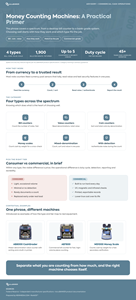
AccuBANKER shows how money counting machines work, the main types from bill and coin counters to value counters and money scales, and how to match the machine to the job.
Legal Disclaimer:
EIN Presswire provides this news content "as is" without warranty of any kind. We do not accept any responsibility or liability for the accuracy, content, images, videos, licenses, completeness, legality, or reliability of the information contained in this article. If you have any complaints or copyright issues related to this article, kindly contact the author above.
